








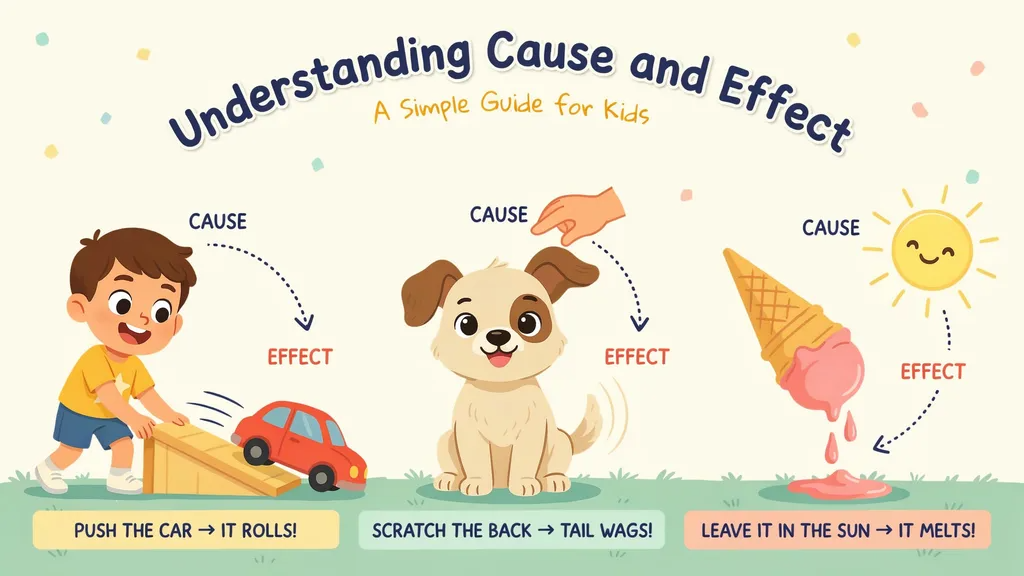
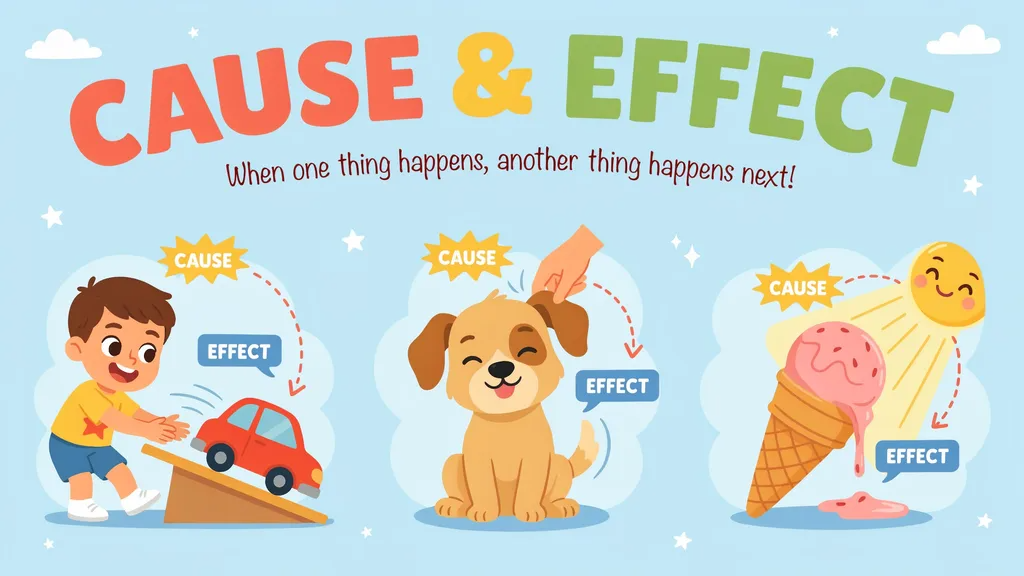
Have you ever wondered why ice cream melts when you leave it out in the sun? Or why your puppy wags his tail when you scratch his back? These are simple questions, but they all point to one amazing idea: Cause and Effect. Every single day, you are surrounded by events that trigger other events. When you do something, something else happens right after. This is how our entire world works, from the biggest storms in the sky to the smallest games we play in our backyards.
Understanding this concept is like having a secret superpower. It helps you figure out puzzles, solve everyday problems, and make smart choices. When you know that your actions lead to specific results, you start seeing patterns everywhere you look. In this guide, we are going to explore how cause and effect shapes our daily lives through fun stories, clear examples, and easy explanations. Get ready to look at the world around you in a whole new way!
What Is Cause and Effect?
At its very core, cause and effect is simply a fancy way of talking about why things happen. The “cause” is the reason why something takes place, and the “effect” is the result that happens because of it. Think of it like a game of dominoes. When you push the first domino over, that push is the cause. The domino falling down is the effect. Every action creates a reaction, and this simple chain reaction is happening all around us all the time.
Children often learn about this concept very early in life through play. If you drop a toy block on the floor, it makes a loud noise. If you pull a cat’s tail, the cat might run away. These moments teach us how our physical environment responds to us. By paying attention to these connections, we build strong logic skills that help us understand our universe better. It is the basic blueprint of how everything connects, from nature to human behavior.
A Closer Look at Everyday Actions
Let us look at some simple moments from everyday life to see this idea in action. Imagine you wake up in the morning and forget to tie your shoelaces before you run outside to play. While you are sprinting across the grass, your foot catches on the loose lace, and you trip. Here, forgetting to tie your shoes is the cause, and taking a tumble is the effect. It is a quick lesson in why little habits matter so much!
Another common example happens right in the kitchen. If you touch a hot stove burner with your bare hand, you will pull your hand back very quickly because it hurts. The hot stove is the cause, and the quick reaction is the effect. Our bodies are naturally wired to learn from these moments so we can stay safe and healthy. Every choice we make sets off a tiny chain reaction that leads to a specific outcome.
The Power of Making Good Choices
When we understand how cause and effect works, we realize that our decisions carry real weight. Every time you make a choice, you are also choosing the result that comes with it. For example, if you study hard for your spelling test all week long, the outcome is usually a great grade on your paper. The hard work is the cause, and the happy smile on your face when you get your test back is the effect.
On the other hand, if you choose to stay up late playing video games instead of sleeping, you will likely feel very tired and grumpy the next day. Being tired makes it harder to pay attention in class or play sports with your friends. By seeing these connections ahead of time, we practice good decision making. We learn that taking care of our responsibilities leads to happy results, while ignoring them leads to tricky problems we have to fix later.
Nature and the World Around Us
Nature is one of the biggest and most exciting places to see cause and effect in action. Have you ever watched dark, heavy clouds roll across the sky on a warm summer afternoon? Soon after the clouds gather, you hear a loud rumble of thunder and see flashes of lightning, followed by heavy rain pouring down. The dark storm clouds are the cause, and the refreshing rainfall is the effect.
Plants and animals experience these natural patterns every single day, too. When the sun shines brightly and spring rain falls on the soil, tiny seeds sprout out of the ground and grow into tall green plants. If a long time passes without any rain, the soil dries out and flowers begin to droop. Animals notice these changes, too, migrating or gathering food when the weather turns cold. Everything in nature is connected in a giant, beautiful web of actions and reactions.
Cause and Effect in Simple Science Experiments
Science is basically the study of finding out why things happen. You can easily test cause and effect right at home or in your school classroom with fun, safe experiments. For instance, imagine filling a tall glass with water and dropping a heavy stone inside it. What happens? The water level rises right up to the top! Dropping the stone is the cause, and the rising water is the effect.
Another fun experiment involves mixing baking soda and vinegar together in a small cup. When the two ingredients touch, they fizz up and create lots of bubbling foam. The mixture of the two substances is the cause, and the fizzy reaction is the effect. Doing these hands-on activities helps your brain lock onto the concepts and makes learning feel like a fun game rather than a chore. Science gives us the tools to test our ideas and watch the results happen right before our eyes.
How Stories and Books Use This Idea
If you love reading adventure books or funny stories, you have already seen cause and effect working behind the scenes. Authors use this pattern to build exciting plots for their characters. If a character makes a silly mistake, like forgetting their magic wand at home, that mistake leads to a big problem they have to solve later in the story. Every twist in the plot happens because of something that came right before it.
Think about your favorite fairy tales. In the story of the Three Little Pigs, the first two pigs built houses out of straw and sticks because they wanted to finish quickly and play. The wolf easily blew those houses down. Building a weak house was the cause, and having the house collapse was the effect. Stories teach us important lessons about life by showing us how characters deal with the results of their choices.
Simple Steps to Spot It Yourself
Becoming a master at spotting cause and effect is easier than you might think. All you have to do is ask yourself two simple questions whenever something happens: “What caused this to happen?” and “What is the result?” When you train your brain to look for these connections, you start solving puzzles much faster. It turns everyday observations into fun learning moments.
Try this the next time you are outside playing a game or watching a pet. If your dog starts barking loudly at the front door, look for the reason why. Did the mail carrier walk up the steps? Is a squirrel running across the fence? Finding the hidden trigger behind an event helps you make sense of the world. It improves your focus, sharpens your logic skills, and makes you a curious explorer of everyday life.
Common Mistakes to Avoid
Sometimes, people get confused and think that because two things happen at the same time, one caused the other. This is a very common mix-up! For example, suppose you wear your lucky red sneakers to school and your basketball team wins the game. It is easy to think that your red shoes caused the victory, but the real cause was all the hard practice your team put in during the week.
It is important to look closely at the facts before deciding why something happened. Just because the sun comes up right before you eat breakfast does not mean your breakfast made the sun rise! Learning to tell the difference between a real connection and a lucky coincidence helps you think clearly and avoid silly misunderstandings. Taking your time to look at the whole picture makes you a smart thinker.
Fun Activities to Practice at Home
You do not need a fancy classroom to keep practicing these skills. You can play fun games right at home with your family or friends. One great game is called “What Happens Next?” You can take turns describing a simple situation—like dropping a glass of milk or planting a sunflower seed—and have the other person guess the exact result. It turns learning into a joyful challenge!
Another fun idea is keeping a daily journal where you write down one interesting thing that happened each day and explain why it took place. You might write about how baking cookies filled the house with a sweet smell, or how watering your indoor plants helped them grow new leaves. Writing these thoughts down helps cement the ideas in your mind while letting you practice your writing and storytelling skills at the same time.
Building Bright Futures Through Logic
When we look at the big picture, understanding cause and effect is one of the most useful skills you can develop as you grow up. Every great inventor, scientist, artist, and leader started by asking simple questions about why things work the way they do. By noticing how our actions create specific outcomes, we learn to take responsibility for our choices and build a wonderful future.
You have the power to create positive effects in your own life every single day. Whether you choose to be kind to a new classmate, study hard for a big test, or practice a musical instrument, your positive actions will always lead to wonderful results. Keep exploring, keep asking questions, and never stop looking for the amazing connections that make our world work!
Frequently Asked Questions
What is the easiest way to understand cause and effect?
The easiest way is to remember that a “cause” is why something happens, and an “effect” is what happens as a result. For example, if it rains (cause), the grass gets wet (effect).
Can an effect have more than one cause?
Yes, absolutely! Sometimes many different things happen together to create a single result. For example, getting a great grade on a test usually comes from studying hard, listening in class, and getting a good night’s sleep.
How does this concept help me in everyday life?
It helps you make smart choices because you learn to think about what might happen before you take an action. It also helps you solve problems quickly when things do not go as planned.
Are cause and effect used in storytelling?
Authors use this pattern to create exciting plots. When a character makes a choice or a mistake, it creates a new problem or adventure that drives the story forward from beginning to end.
How can I practice spotting these patterns?
You can practice by looking at things happening around you, like watching how plants react to sunlight or seeing how animals behave when it gets cold outside, and asking yourself why those things happen.
Why is this important for science?
Science is all about testing ideas to see what happens. When scientists run experiments, they change one thing to see how it affects another, which helps them discover new facts about our universe.
Conclusion
Every action we take creates a ripple in the world around us. By understanding cause and effect, you unlock the secret to how everyday life, nature, and science connect. Start looking for these patterns in your daily routine, make smart choices, and watch how your positive actions lead to amazing results. What interesting connection will you discover today?