







Getting ready for the big test can feel a bit overwhelming, but you do not have to stress out. Let us talk about one of the easiest ways to boost your score: mastering SAT Grammar Rules. When you know what the test makers are looking for, the English section becomes much less scary. Think of these rules like the secret cheat codes to a video game. Once you learn them, you can spot the tricks hiding in every single question.
Many students think English is just about what sounds right to your ear. While that helps sometimes, the test loves to trick you with sentences that sound okay out loud but are actually broken on paper. By learning core sat grammar rules, you train your brain to look for patterns. You will start seeing the same traps pop up over and over again. Let us break down everything you need to know in a fun, super simple way so you can walk into that test room feeling totally ready and confident.
What Are SAT Grammar Rules and Why Do They Matter?
Before we jump into the fun stuff, let us talk about what these rules actually are. The writing section of the test is officially called the Writing and Language test. It tests how well you can edit and fix text. You have to find mistakes in punctuation, sentence structure, and word choice. Knowing your sat grammar rules is the best way to get these questions right every single time.
You might be wondering why the test cares so much about this. Colleges want to make sure you can write clearly when you get to campus. If your papers are full of messy sentences, professors will have a hard time reading them. When you master standard sat grammar rules, you show colleges that you are ready for big-time academic writing. Plus, getting these questions right is the fastest way to pull your overall score up without having to memorize a million hard vocabulary words.
Conquering Comma Splices and Run-on Sentences
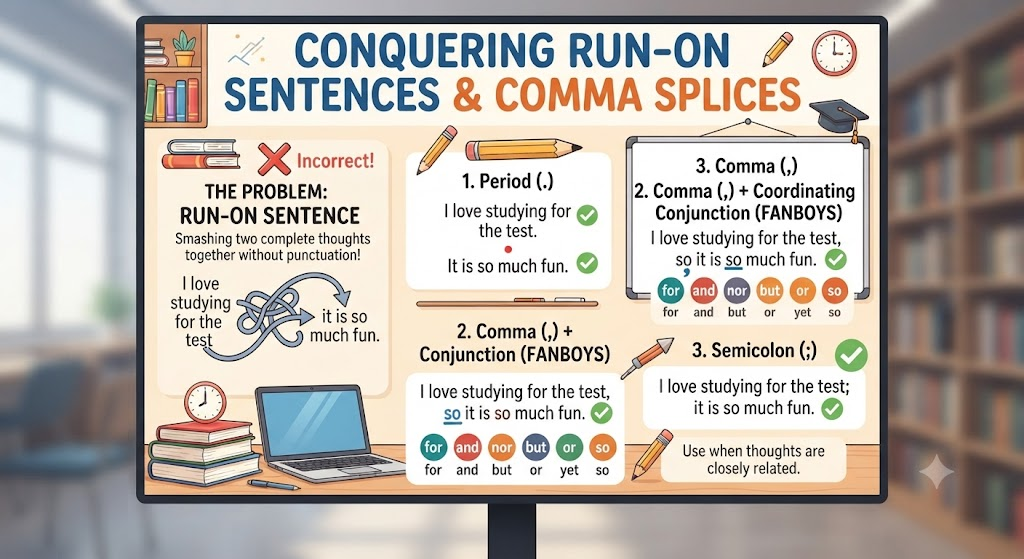
Let us start with one of the most common mistakes students make: the run-on sentence. A run-on happens when you smash two complete thoughts together without the right punctuation. For example, saying “I love studying for the test it is so much fun” is a major grammar trap. To fix this using your sat grammar rules, you have to separate those thoughts properly.
You have a few easy ways to fix a run-on. First, you can drop a period right in the middle to make two short sentences. Second, you can use a comma combined with a connecting word like and, but, or so. Finally, you can use a semicolon if the two thoughts are closely related. Practicing this specific part of sat grammar rules will save you from losing easy points on test day.
Mastering Semicolons and Colons Like a Pro
Semicolons look super fancy, but they are actually very simple once you get the hang of them. A semicolon is basically a soft period. You use it to link two complete sentences that hang out together and share a big idea. If you can put a period between the two thoughts, you can usually use a semicolon instead. This is a favorite trick tested by standard sat grammar rules.
Colons, on the other hand, are like a drumroll in written form. You use a colon after a complete sentence to introduce a list, an explanation, or a big reveal. For example: “I need to pack three things for test day: pencils, an eraser, and my ID.” Remembering how colons work is a huge part of acing the punctuation section using reliable sat grammar rules.
Subject-Verb Agreement: Making Friends Match
Words in a sentence have to get along just like best friends. This is called subject-verb agreement, and it is a massive piece of the sat grammar rules puzzle. If your subject is singular, your verb needs to be singular too. If your subject is plural, your verb must match that plural vibe. It sounds super simple, but the test makers love to hide long phrases between the subject and the verb to confuse you.
Imagine a sentence like, “The box of shiny red apples are sitting on the desk.” It might sound okay if you read it fast, but it is totally wrong. The subject is box, not apples. Since one box is singular, the verb needs to be is. Spotting these sneaky separation tricks is one of the best skills you can build while studying your sat grammar rules.
Pronoun Power: Keeping Antecedents Clear
Pronouns are tiny words like he, she, they, and it that step in so you do not have to repeat a noun a million times. But pronouns can cause big trouble if we do not know who or what they are talking about. A core part of sat grammar rules is making sure every pronoun has a crystal-clear antecedent, which is the original noun it replaces.
If a sentence says, “Mark told John that he won the award,” we have a mystery on our hands. Who won the award? Mark or John? The pronoun he is totally unclear. The test will try to trick you with muddy pronouns all the time. When you review your sat grammar rules, always hunt down the exact noun that every single pronoun is pointing back toward.
Modifier Placement: Keeping Modifiers Close to Home
Modifiers are descriptive words or phrases that paint a picture in the reader’s mind. But here is the golden rule of modifiers: they have to stand right next to the exact thing they are describing. If they wander too far away, funny things happen. This is a classic trap found within official sat grammar rules questions.
Consider this funny example: “Running down the street, the backpack fell off my shoulders.” That sentence makes it sound like an innocent backpack was going for a morning jog! The modifier running down the street is stranded far away from the person actually doing the running. Fixing misplaced modifiers is a fantastic way to make your writing sharp and pass those tricky editing questions.
Parallel Structure: Keeping Your Lists Balanced
When you write a list or compare two things, your sentence needs to keep a nice, even rhythm. This is called parallel structure, and it is a super satisfying part of sat grammar rules to master. If your list starts with an action word ending in -ing, every single item in that list needs to follow the exact same pattern.
For example, saying “I love reading, writing, and to swim” breaks the rhythm. That last item ruins the flow. To fix it using proper sat grammar rules, you change it to “reading, writing, and swimming.” Keeping your verbs and phrases balanced makes your sentences sound smooth, polished, and ready to score top marks on the exam.
Apostrophes for Possession and Contractions
Apostrophes are tiny punctuation marks that pack a huge punch. Students often mix them up, making apostrophe questions a goldmine for the exam. When you look at sat grammar rules, apostrophes generally do two main jobs: they show ownership, or they mash two words together to form a contraction like do not into don’t.
Be extra careful with possessive pronouns like its. Unlike regular nouns, the possessive pronoun its does not take an apostrophe. It’s with an apostrophe always means it is. The test makers love to test this exact difference because so many people mess it up in everyday life. Learning this distinction will give you an instant edge on test day.
Choosing the Right Transitions for Smooth Flow
Transitions are the glue that holds a piece of writing together. Words like however, therefore, meanwhile, and consequently tell the reader how two different sentences relate to each other. Understanding transition logic is a major requirement when studying your sat grammar rules for the digital test format.
If the second sentence contradicts the first one, you need a contrast word like however or nevertheless. If the second sentence is a direct result of the first, you want a word like therefore or as a result. Do not just pick a transition because it sounds fancy. Always read the sentences before and after to figure out the true relationship between them.
Effective Concision and Avoiding Wordiness
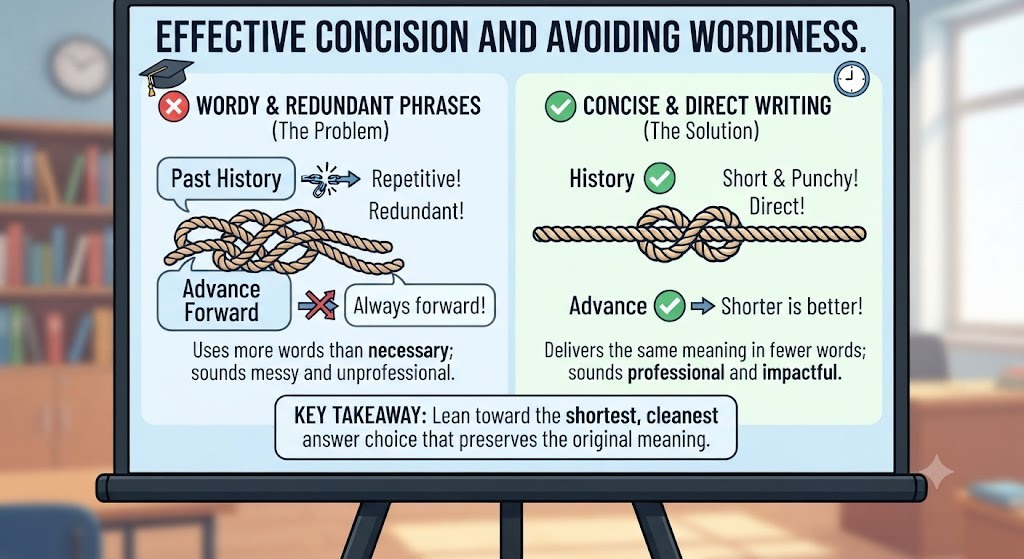
Sometimes, the best writing is the shortest writing. The test loves to check if you can cut out messy fluff and get straight to the point. This concept, often called concision, is a crucial part of mastering overall sat grammar rules. If a sentence uses ten words to say something that can easily be said in four words, the shorter choice is almost always the right answer.
Watch out for repetitive phrases like “past history” or “advance forward.” History is already in the past, and you can only advance forward! Cleaning up redundant phrasing makes your writing sound professional and punchy. When in doubt on the exam, lean toward the clean, concise answer choice that delivers the exact same meaning with fewer words.
Complete Detailing Table: Quick Grammar Reference
| Grammar Concept | Common Trap | Quick Fix / Rule |
| Run-on Sentences | Combining two complete thoughts without punctuation. | Use a period, a semicolon, or a comma with a coordinating conjunction. |
| Subject-Verb Agreement | Getting tricked by long descriptive phrases between nouns and verbs. | Cross out the middle fluff to find the true subject and match the verb. |
| Pronoun Clarity | Using pronouns like he or they with no clear noun match. | Ensure the antecedent is explicitly stated right next to the pronoun. |
| Misplaced Modifiers | Placing descriptive phrases far away from the word they modify. | Keep the modifier touching the exact noun it is describing. |
| Parallel Structure | Mixing different verb forms or phrase types in a single list. | Match the grammatical form of every item in your list. |
Frequently Asked Questions
What are the most important sat grammar rules to memorize?
The most heavily tested concepts include subject-verb agreement, punctuation rules for commas and semicolons, pronoun clarity, and parallel structure. Focusing your study time on these core areas will give you the highest return on your investment.
How can I improve my score on the English section quickly?
Practice active reading and take official practice tests under real time conditions. When you miss a question, review the explanation carefully to understand which specific rule was being tested so you do not repeat the same mistake.
Are semicolons hard to use on the test?
Not at all! Just remember that a semicolon connects two complete, independent sentences that share a related idea. If you can use a period in that exact spot, a semicolon will almost always work too.
How do I fix run-on sentences easily?
Look for places where two full thoughts are jammed together without proper punctuation. You can fix them by adding a period, a semicolon, or a comma followed by a conjunction like and or but.
Why do modifier placement questions trick so many students?
They trick students because our brains often fill in the blanks automatically when we read fast. To beat this trap, always check what noun the opening descriptive phrase is sitting right next to.
Is shorter always better on the writing section?
Most of the time, yes! The test heavily rewards concision. If two answer choices are both grammatically correct, the shorter, clearer, and more direct option is usually the correct answer.
Conclusion
Mastering your sat grammar rules does not have to feel like an impossible mountain to climb. By taking things one concept at a time, practicing with real examples, and keeping your eye out for classic test traps, you can completely transform your confidence. Every small step you take brings you closer to that dream score and opens up amazing opportunities for your future. Keep practicing, stay positive, and go crush that test!