









Would you rather take one million dollars right now or start with A Penny Doubled Everyday for 30 Days? Most people take the quick million dollars because it feels safe and fast. However, taking the multiplying penny is actually the choice that makes you rich beyond your wildest dreams.
When I first learned about this classic money riddle in school, I completely picked the wrong answer. I thought one million dollars cash was huge money compared to a tiny copper coin. But the math behind a penny doubled everyday for 30 days proves how exponential growth works over time.
Understanding this idea helps you build real wealth in everyday life. Small amounts of money saved today can turn into massive sums when you let compounding do the heavy lifting. Let us break down the exact numbers step by step so you can see the magic happen.
The Ultimate Choice: One Million Dollars or a Doubling Penny?
Imagine a wealthy person walks up to you today with two distinct offers on the table. Offer A is a sleek suitcase holding one million dollars in cash right now. Offer B is a single cent that doubles in total value each day for one full month.
At first glance, taking the instant cash seems like a total no-brainer decision for anyone. Who would want to wait a whole month for pennies when a million dollars is sitting right there? Yet, choosing a penny doubled everyday for 30 days turns out to be worth over five million dollars by month end.
The secret relies entirely on how fast doubling works once the baseline numbers get larger. Early on, the growth looks super slow and boring to watch. But as the total grows, each new double creates huge jumps in wealth very quickly.
How Exponential Growth Makes Small Numbers Huge
Exponential growth happens when a sum multiplies by a fixed rate repeatedly over time. Instead of adding a fixed dollar amount each morning, you double the whole sum from yesterday. That means your money builds momentum like a small snowball rolling down a steep snowy mountain.
When you track a penny doubled everyday for 30 days, the first two weeks feel completely disappointing. You start with one cent, then two cents, then four cents, which barely buys anything at all. In fact, after ten full days of waiting, you still have less than six total dollars.
Most people give up on saving money early because the growth feels way too slow at the start. However, if you remain patient, exponential growth suddenly explodes into giant numbers near the end.
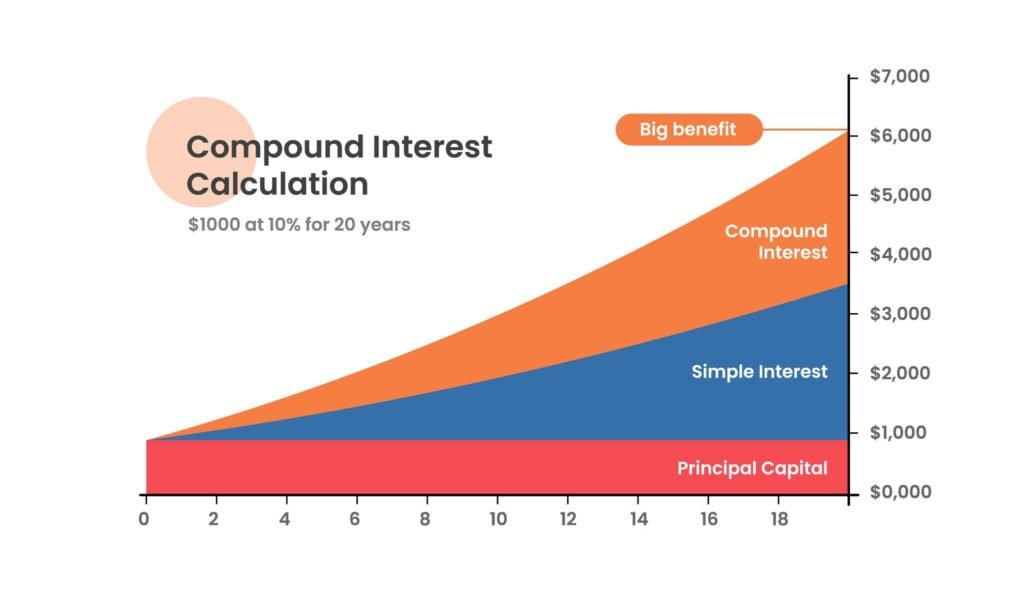
Exponential growth curve of compounding. Source: ribkhan / Getty Images
Complete Day-by-Day Breakdown Table for 30 Days
Here is the exact day-by-day table showing how a single penny multiplies into millions over one month.
| Day | Calculation Formula | Daily Total Value |
| Day 1 | Start with $0.01 | $0.01 |
| Day 2 | $0.01 × 2 | $0.02 |
| Day 3 | $0.02 × 2 | $0.04 |
| Day 4 | $0.04 × 2 | $0.08 |
| Day 5 | $0.08 × 2 | $0.16 |
| Day 6 | $0.16 × 2 | $0.32 |
| Day 7 | $0.32 × 2 | $0.64 |
| Day 8 | $0.64 × 2 | $1.28 |
| Day 9 | $1.28 × 2 | $2.56 |
| Day 10 | $2.56 × 2 | $5.12 |
| Day 11 | $5.12 × 2 | $10.24 |
| Day 12 | $10.24 × 2 | $20.48 |
| Day 13 | $20.48 × 2 | $40.96 |
| Day 14 | $40.96 × 2 | $81.92 |
| Day 15 | $81.92 × 2 | $163.84 |
| Day 16 | $163.84 × 2 | $327.68 |
| Day 17 | $327.68 × 2 | $655.36 |
| Day 18 | $655.36 × 2 | $1,310.72 |
| Day 19 | $1,310.72 × 2 | $2,621.44 |
| Day 20 | $2,621.44 × 2 | $5,242.88 |
| Day 21 | $5,242.88 × 2 | $10,485.76 |
| Day 22 | $10,485.76 × 2 | $20,971.52 |
| Day 23 | $20,971.52 × 2 | $41,943.04 |
| Day 24 | $41,943.04 × 2 | $83,886.08 |
| Day 25 | $83,886.08 × 2 | $167,772.16 |
| Day 26 | $167,772.16 × 2 | $335,544.32 |
| Day 27 | $335,544.32 × 2 | $671,088.64 |
| Day 28 | $671,088.64 × 2 | $1,342,177.28 |
| Day 29 | $1,342,177.28 × 2 | $2,684,354.56 |
| Day 30 | $2,684,354.56 × 2 | $5,368,709.12 |
Why the Early Results Feel Disappointing
During the first week of a penny doubled everyday for 30 days, you will feel like you made a terrible mistake. On day one, you have one single cent in your palm. By day seven, your total cash reaches a grand total of just 64 cents.
If you chose the penny, your friends who took the million dollars are buying sports cars while you cannot even buy a candy bar. This stage tests your mindset and personal patience. Most people abandon long-term financial plans right here because the visible progress seems almost invisible.
However, this slow growth phase is essential for building a foundation. In mathematics and investing, small beginnings always precede giant breakthroughs if you hold on long enough.
Small Gains Start Building a Foundation
During the second week, the numbers start picking up a little bit of speed. By day ten, your single penny turns into five dollars and twelve cents. By day fourteen, you pass eighty dollars in total cash value.
While eighty dollars is not life-changing money, compare it to where you started two weeks ago. Your money has grown eight thousand times larger than your original single cent. That speed of growth is the true magic behind a penny doubled everyday for 30 days.
This period represents the mid-game of building personal savings. You begin noticing real progress in your bank account, which keeps you motivated to keep saving consistently.
Crossing the Thousand Dollar Threshold
Week three is where the math starts looking truly unbelievable for anyone watching. On day eighteen, you break through the one thousand dollar mark with $1,310.72. By day twenty-one, your total balance leaps to over ten thousand dollars.
Notice how fast the jumps happen now compared to the first week. Doubling ten dollars only added ten dollars to your balance back on day eleven. But doubling five thousand dollars on day twenty instantly adds another five thousand dollars overnight.
This rapid growth shows why time is the most valuable tool for accumulating wealth. The longer you let your money stay invested, the bigger each future jump becomes.
The Incredible Million-Dollar Explosion
The final week delivers an astonishing surge in overall net worth. On day twenty-eight, your balance officially surpasses the original one million dollar offer, reaching $1,342,177.28. You are now richer than the person who took the instant cash suitcase!
On day twenty-nine, your money doubles again to over 2.6 million dollars. Finally, on day thirty, a penny doubled everyday for 30 days reaches a grand total of $5,368,709.12.
You earned over four million extra dollars simply by waiting thirty days instead of taking the upfront cash. That massive gap demonstrates why smart investors always focus on long-term growth over short-term gains.
What Happens If the Month Has 31 Days?
If you run this experiment during a 31-day month like July or October, the final figure becomes mind-blowing. Doubling your day thirty balance of $5,368,709.12 one more time yields an incredible $10,737,418.24.
A single extra day doubles your entire wealth, adding over five million dollars in twenty-four hours. This dramatic shift highlights the power of compound interest late in the game.
It proves that the biggest financial rewards always arrive at the very end of your investment journey. Staying invested for just a little longer can completely transform your long-term results.
The Real-World Lesson: Understanding Compound Interest
While no bank pays a 100% daily interest rate in real life, the penny riddle teaches a vital financial lesson. Compound interest works on the exact same mathematical formula as our doubling penny. You earn interest on your principal balance plus the accumulated interest from past months.
When I started investing a small portion of my paycheck every month, it felt painfully slow at first. My gains were only a few dollars per year, which felt barely noticeable. But over time, those returns began generating their own returns, causing my portfolio to grow faster every season.
Starting early gives your money more time to double and grow. Even small monthly contributions can build significant wealth over decades thanks to the power of compounding.
Common Mistakes That Stop People From Building Wealth
The biggest mistake people make with money is impatience. They want instant results, so they take the quick million dollars or spend their savings early. When you break your investment cycle early, you miss out on the massive gains waiting at the end.
Another common mistake is waiting for the “perfect time” to start saving money. People think they need thousands of dollars before they can begin investing for their future. But as our penny example shows, starting small today is far better than starting big tomorrow.
Finally, pulling your money out during market drops destroys your compounding momentum. Consistency and patience are the two absolute keys to achieving financial freedom over time.
Frequently Asked Questions
What is the formula used for a penny doubled everyday for 30 days?
The formula used is V=P×2(n−1), where P is the starting principal ($0.01) and n is the total number of days.
Is it better to take $1 million or a doubling penny for 30 days?
It is far better to take the doubling penny because it yields $5,368,709.12, which is over five times more money than $1 million.
How much is a penny doubled for 30 days worth on day 15?
On day 15, the doubling penny is worth exactly $163.84, which still looks small before the late-month explosion.
How much money do you have on day 20 of doubling a penny?
On day 20, your balance grows to $5,242.88 as the exponential growth curve begins to steepen significantly.
Does a 31-day month make a huge difference in the total?
Yes, adding a 31st day doubles the final total from $5.36 million to an astonishing $10,737,418.24.
Can you actually get a 100% daily return on real investments?
No real-world bank or stock market offers 100% daily returns, but the riddle illustrates the long-term mechanics of compound interest.
Conclusion
The story of a penny doubled everyday for 30 days is more than just a fun math riddle. It serves as a powerful lesson on patience, exponential growth, and long-term financial planning. Small choices made consistently every single day lead to life-changing results over time.
You do not need a million dollars in cash to begin building your financial security today. Start by saving small amounts regularly, remain patient through the slow early phases, and let compounding do its work. What is one small step you can take today to start growing your savings?